
Looking back at this summer and some reflections on EAA 2025
Days are getting shorter and nights colder, clear sign that summer is slowly coming to an end and autumn, and new academic year, is coming. In my last post I mentioned that my summer in fact is going to be quite busy as I need to work on a least-cost path network model of the Roman roads in the Levant and prepare for presenting it at the EAA (European Association of Archaeology) conference that unfolded last week (2-6 September). And busy summer it was…
My idea was to try different network construction techniques to model theoretical LCP networks, such as Delaunay triangulation (DT), Gabriel graph (GG), Relative Neighbourhood graph (RNG) and K-nearest neighbours (K-NN) and compare them with the network structure of the Roman road network in the southern Levant - which is exceptionally well researched and described and so is very likely closest to the “real” road network as it existed in the Roman period. In the next step then, we may attempt to reconstruct Roman road network in a region where we now little about the ancient road network and “fill the gaps” using appropriate network construction method. Of course it was not that simple…
Sometimes you get too little edges (RNG), or too many (DT), or it overconnects sites within a single cluster (K-NN). Interestingly Gabriel graph comes closer to represent the Roman road network in the Levant with some 80% of Roman roads correctly predicted. This is quite important, since recently it was argued in an article by Groenhuijzen and Verhagen (2017) that Gabriel graph is the best approximation of the potential Roman transport network on the Dutch limes. So my analysis independently confirms their conclusions.
However, I was not really content with Gabriel graph since since some major roads were not present in this model and I was looking for alternative approaches. I found these in two articles by Carroll and Carroll 2022 and 2023. In short, they introduce L coefficient representing ratio between built and travel costs. Road between two points is created only if there is no “cheaper” route through a third point and this is evaluated using L coefficient and travel costs between the three points. Another option is connecting sites to pre-defined “trunk” roads using T-junctions and employing similar comparison of travel costs as in the first case.
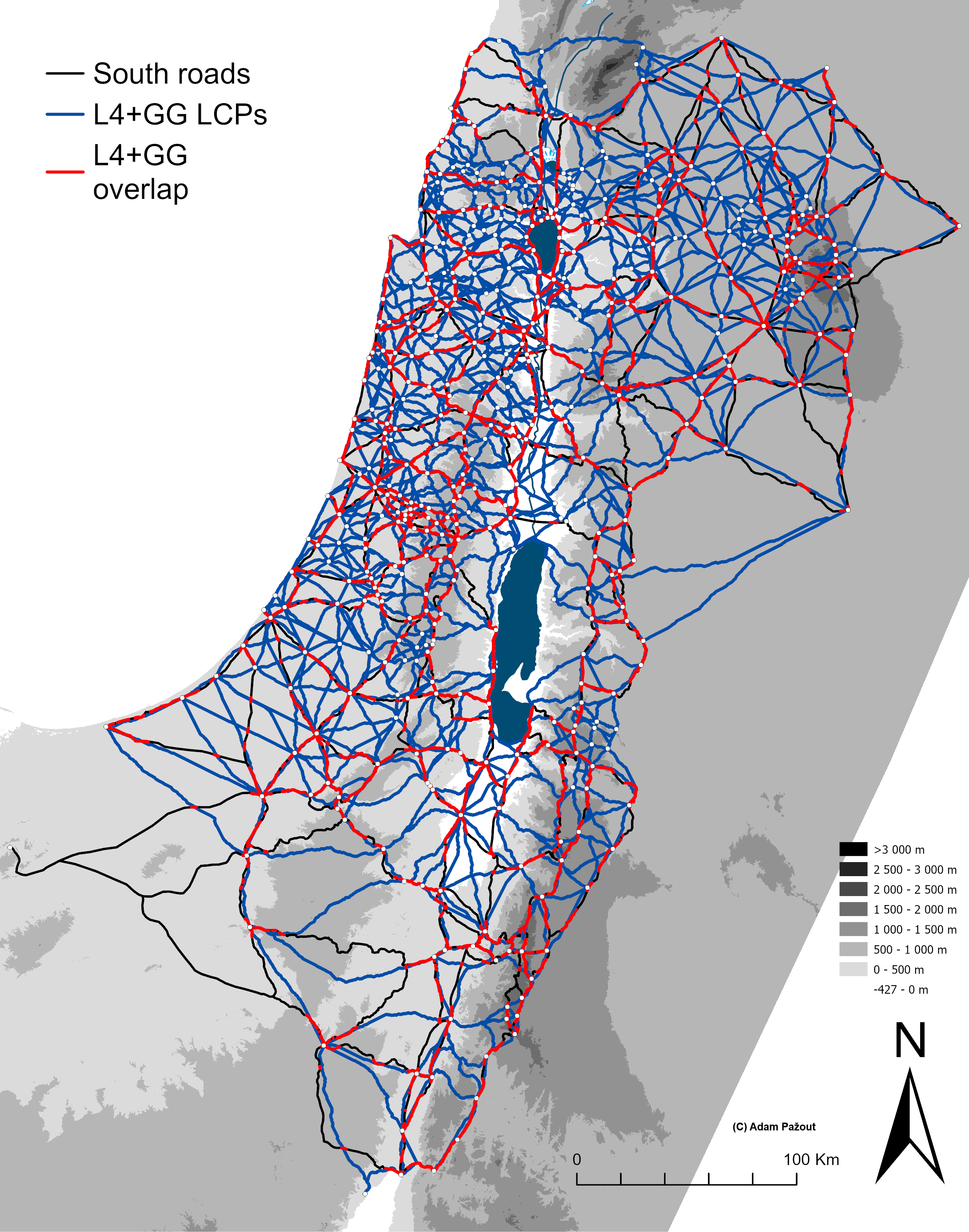
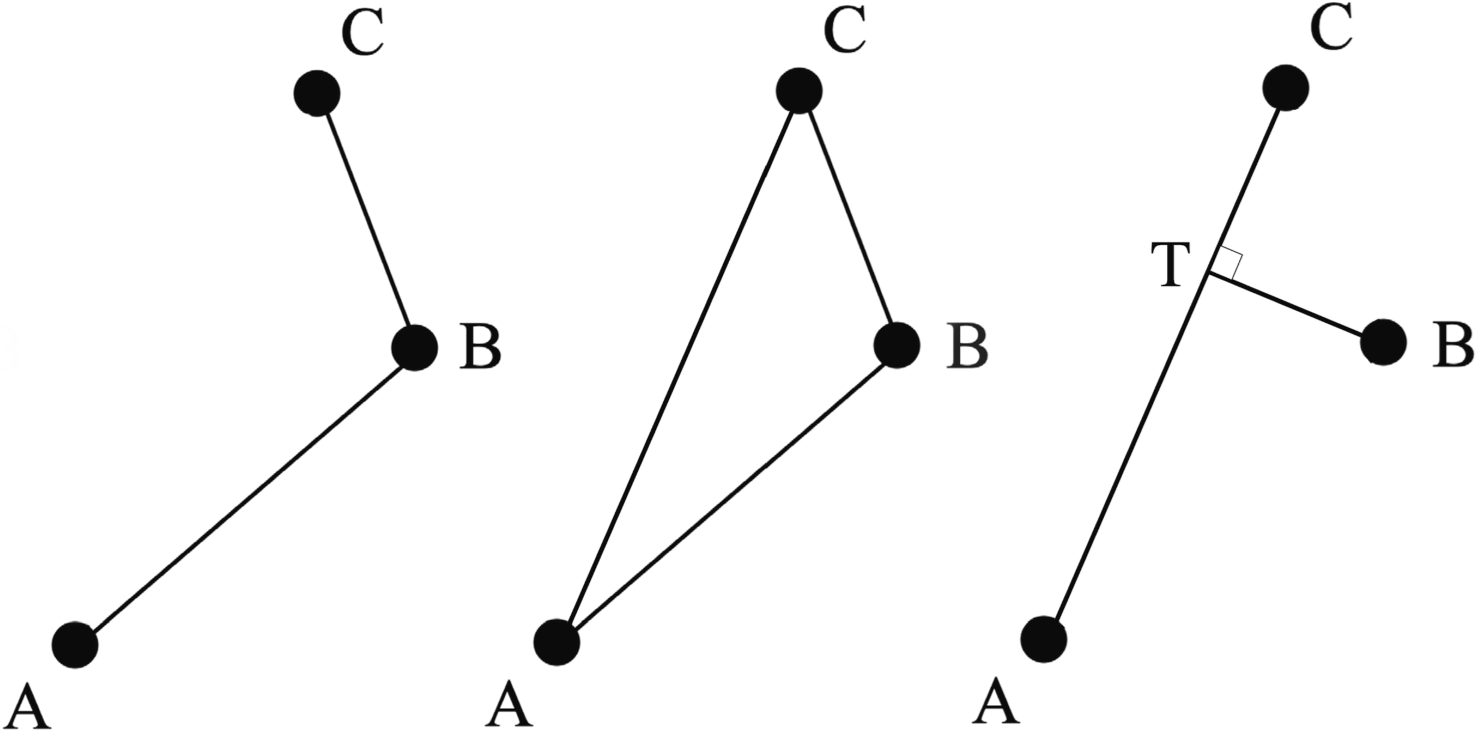 I was quite impressed with the results, where for L=4 some 80% of Roman roads are correctly predicted, but then there were some gaps not appearing in some of the previously modeled networks. So in order to fill the gaps in L=4 network I combined it with Gabriel graph and voilà we get about 86% of edges in the Roman road network, which seems amazing! This is interesting, since Carroll and Carroll claims that L=7 best represents the Roman road network in their researh region, so on this my results diverge from them… The big con of this method is the number of edges (=roads) that is generated and that vastly outnumbers the number of edges in the original Roman network. So the next step is validation and further pruning of edges. At the same time I want to try the T-junction method with pre-defined “trunk” roads - mainly in order to get some of the major roads that are still missing from L=4 network into the model.
EAA Conference 2025 This year’s EAA was… disappointing, and some aspects of it left me quite annoyed. But first of all I need to express big thanks to Andrew McLean, James Page and María Coto for organizing our amazing session “Moving forward: New applications and developments in archaeological mobility studies” with so many interesting papers ranging from isotope studies to advanced spatial methods, and including my humble contributions on LCP networks. But that’s probably the only good thing I can say about the EAA. This year’s conference was completely online with all accompanying problems - poor connection on the side of some participants, poor microphones (so that whole presentation is totally incomprehensible), weird and totally useless experiments (playing your presentation from an iphone is not ok), bad and barely functional online platform, and generally just lack of social contact and discussions with friends and colleagues in between session. I do understand why Serbian colleagues decided not to organize in-person conference in Belgrad in light of police violence and disruptions to academic and university life in the city, and I want to express my support to the people of Serbia in their struggle against their corrupt political elites. At the same time I hope that there won’t be another online conference for a long time…
But there was another aspect of conference which left me deeply disgusted.
Here, I need to admit one thing - I am not particularly interested in inner workings of professional associations like EAA and I am certainly not an active member. That means I know very little about what is going on and this year I just watched with disbelief what unfolded last week before and during the conference.
So apparently this spring, EAA Executive Board decided to remove institutional affiliation of Israel-based researchers because of the war in Gaza. I couldn’t find the original decision on the EAA website, so here I am relying on the email to session organizers from September 2nd.
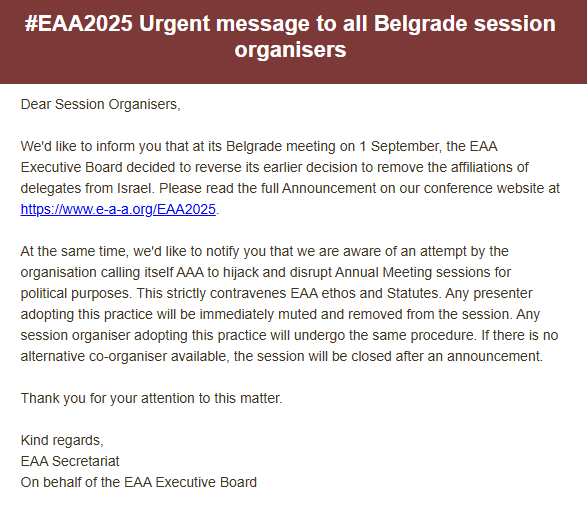
The removal of the institutional affiliation is in my view silly and don’t really serve anything. I don’t support collective punishment of anyone just because of the actions of their government. Should any individual be inciting violence, calling for genocide, or behaving in any other way against the code of conduct/statutes etc. of the EAA then it is sure right to expose such individual and exclude them for the organisation, but in my opinion this must be evaluated on case-by-case basis. In the same email, the organizers wanted to warn us that there might be attempts to disrupt the conference “for political purposes” so likely a pro-Palestine protest of a sort. And then another thing happened…
On the same day September 2nd just shortly before the start of the conference an email addressed to volunteers (managing meeting rooms on zoom) got leaked to the public. The content is simple: we anticipate disruptions - in the form of reading a political statement - should this happen, remove the individual from the session, if such an individual is a session organizer, the session will be cancelled.
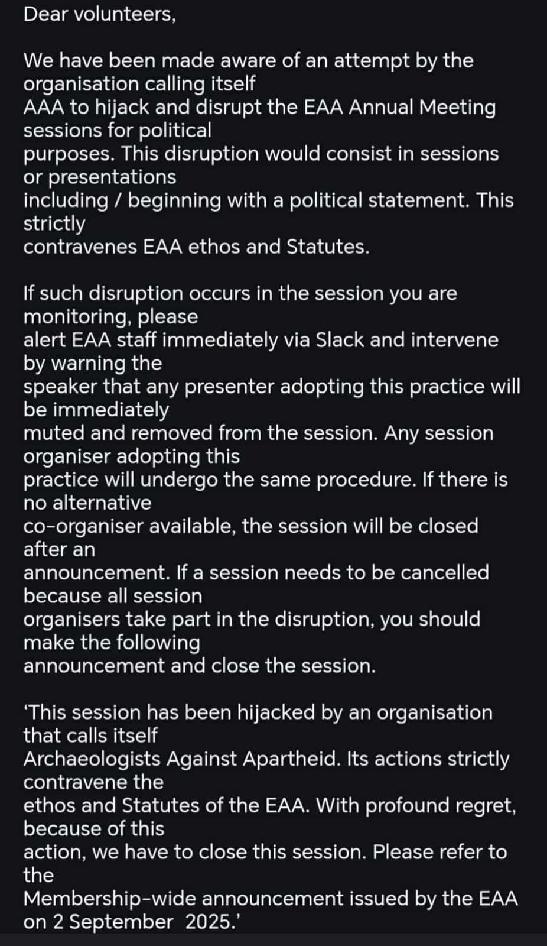
This obviously enraged many people (me included) - they basically asked volunteers to kick you out of a session just for expressing your opinion. Generally, I am not a big fan of making political statements on archaeological conferences. I think it is not a right platform for this kind of expression, with exceptions directly related to our domain, such as defense of cultural heritage, academic life and freedoms and such. But don’t get me wrong - I don’t want to ban people from conferences for expressing their opinions like EAA attempted. So now there were people upset about reversal of decision on Israeli affiliations and people upset about suppression of free speech, and people who were not political before the conference got very political overnight. With our session organizers we discussed if we should boycott the conference or make statements at the beginning of the session and see what happens. I want to proceed with the session as I felt it would be unfair to the speakers who were prepared to deliver their presentations. We decided to make a statement and proceed. Obviously at that time (Wednesday morning) there was a big humbug about it with everyone talking and EAA attempted some damage control saying that you won’t be kicked out of session for this etc. So our session (despite some technical difficulties) could proceed quite normally.
Something should happen at the EAA so that collective punishment is not meted out to people for living in the “wrong” country, and so that open and free discussion can be maintained at the conference, even for people you disagree with.